Floaters are small shapes, threads, or specks that drift through your field of vision. They are caused by tiny clumps of collagen fibers inside the vitreous - the clear gel filling the back of the eye. As the vitreous ages, it slowly liquefies and condenses, and these collagen clumps cast shadows on the retina that appear as floaters. Most floaters are harmless and related to a normal age-related process called posterior vitreous detachment (PVD).
Gradual onset of a few floaters, especially in people over 50, is usually normal and benign. However, certain patterns warrant urgent evaluation because they can signal a retinal tear or detachment that requires immediate treatment:
If any of these occur, call us immediately at 281-800-1585 or go to the emergency department. A dilated exam the same day is essential. Retinal detachments that are caught early can often be repaired with minimal vision loss. Retinal detachments that are not treated quickly can cause permanent vision loss.
Most floaters do not need treatment. The brain often learns to ignore floaters over months, and what was initially very noticeable fades into the background. For persistent, visually significant floaters - particularly discrete Weiss-ring floaters that repeatedly obstruct central vision - laser vitreolysis may be an option. Observation is always the first-line approach; treatment is considered only when floaters meaningfully interfere with daily activities.
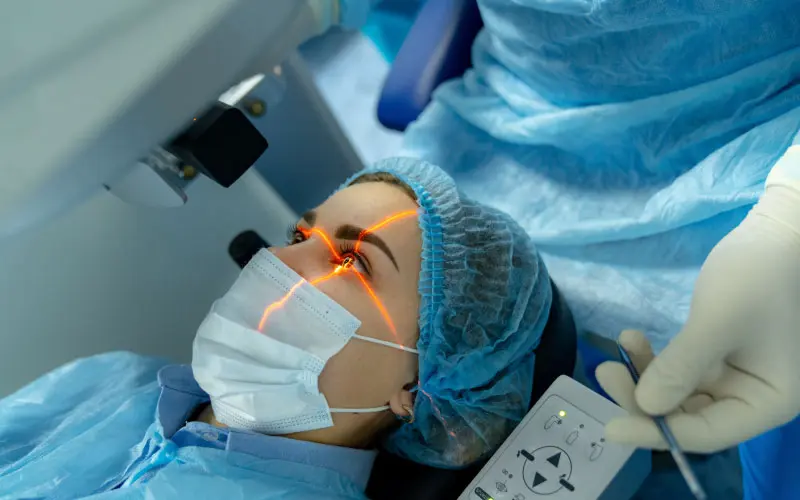
YAG laser vitreolysis uses a focused laser to vaporize or break up vitreous opacities into pieces small enough to be visually imperceptible. The procedure is performed in-office, similar to YAG capsulotomy. Treatment sessions take 15 to 30 minutes. Multiple sessions may be needed depending on the number and position of floaters.
Not all floaters are treatable with laser. The best candidates have:
Diffuse, cobweb-like floaters are much less responsive to laser vitreolysis. Floaters very close to the retina may carry higher risk with laser treatment. Patients with certain retinal conditions are not candidates. Dr. Collett performs a detailed vitreous examination with dilation to confirm candidacy before recommending YAG vitreolysis.
Most patients report improvement after treatment. Residual floaters are common - the goal of YAG vitreolysis is meaningful reduction in symptomatic floaters, not complete elimination. Some patients need a second session to address floaters not fully treated in the first. Minor dark specks may persist and fade over weeks as they settle. Recovery is minimal: anti-inflammatory drops for a few days, no activity restrictions once dilation wears off.
Every floater evaluation begins with a dilated retinal exam to rule out a retinal tear, detachment, or other pathology. If the floater is benign and treatable, Dr. Collett discusses whether YAG vitreolysis is reasonable or whether observation is the better path. When a floater is beyond our scope (retinal pathology requiring retina-specialist intervention), we refer promptly to trusted colleagues.
Floaters are collagen fiber clumps in the vitreous gel, most commonly related to age-related posterior vitreous detachment (PVD). Certain medical conditions and prior eye surgeries can also contribute.
Observation is the most common approach - the brain often adapts to floaters over time and they become less noticeable. No eye drops or supplements reliably eliminate floaters.
A laser procedure that vaporizes or breaks up vitreous opacities to reduce the visual impact of bothersome floaters.
Risks include temporary pressure elevation, transient inflammation, and in rare cases damage to the lens or retina. Candidacy screening and careful laser targeting minimize these risks.
One to two sessions is typical. Some patients achieve their goal in one session; others benefit from a second session to address additional floaters.
Sudden onset of many new floaters, flashes of light, a curtain across vision, or loss of peripheral or central vision require same-day evaluation to rule out retinal tear or detachment.
Call 281-800-1585 or request an appointment online. See also our laser procedures hub.